
 Ekani Ella
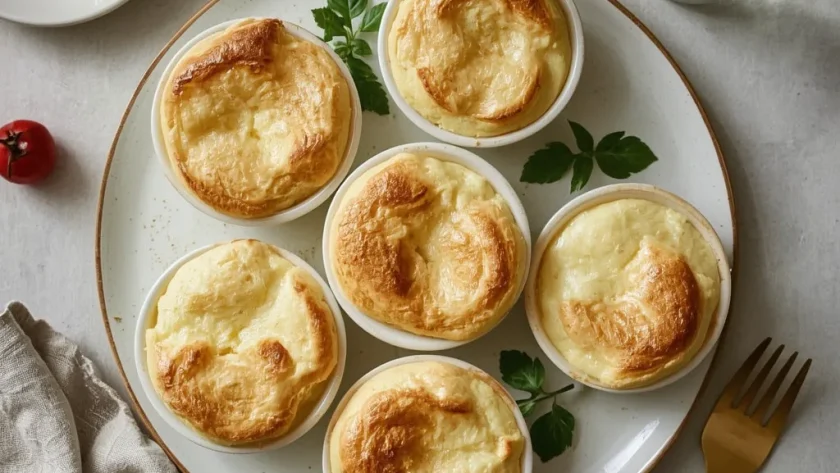
Mary Berry Twice-Baked Cheese Soufflés Recipe makes a light Cheddar soufflé that is baked once to set, turned out of its ramekin, then baked again in seasoned cream until puffed and golden. The result is a crisp top over a soft, custardy centre — classic French bistro cooking made manageable at home.
Total time is 75 minutes, with 25 minutes of prep and 35 minutes of cooking. It sits at intermediate level: the only real pressure point is folding the egg whites, where a light hand matters more than speed. Best served as a main course for a small dinner party, since everything can be prepared hours ahead.
What is Mary Berry Twice-Baked Cheese Soufflés Recipe?
It is a savoury soufflé built on a thick cheese sauce, lightened with whisked egg whites and baked in individual ramekins. The first bake sets the structure, a full cooling lets them shrink cleanly from the sides, and a second bake in cream brings them back to life. Texture is the whole point: crisp, blistered cheese on top, a soft custard beneath, and a savoury cream sauce pooling around the base. Making it ahead removes the usual soufflé panic, which is why it suits a dinner party starter or a light main.
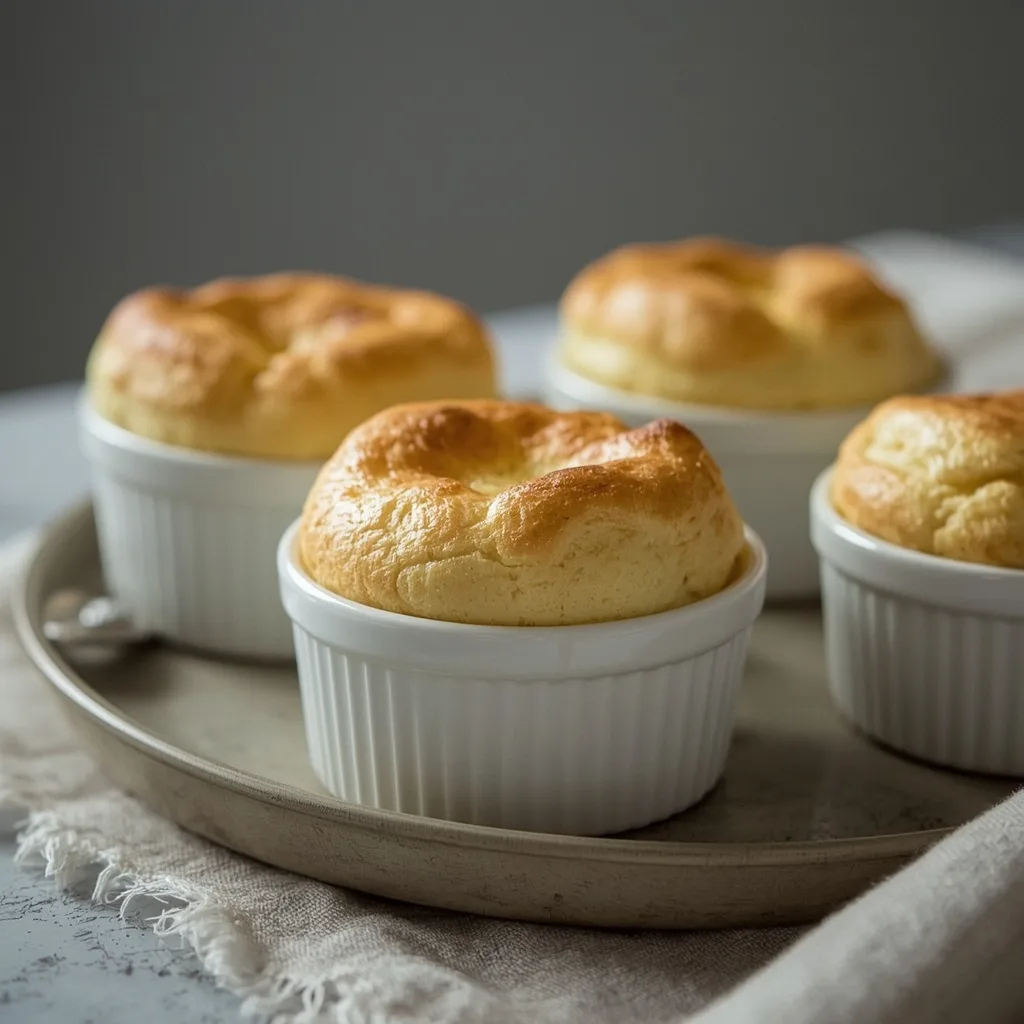
Why This Recipe is Worth Trying
- Make-ahead freedom — the first bake and turning out can be done up to 24 hours ahead, so nothing is rushed at serving time.
- Forgiving rise — the second bake does the puffing, so a slightly deflated first attempt still comes out looking generous.
- Big flavour from few ingredients — mature Cheddar, Dijon and cayenne do all the heavy lifting without a long shopping list.
- Impressive plate, low stress — it looks like restaurant food but is assembled in stages you control.
- Freezer friendly — first-bake soufflés freeze for up to a month, making this a realistic make-ahead dish.
Essential Ingredients to Make Mary Berry Twice-Baked Cheese Soufflés Recipe
Sixteen items, most of which you probably already have in the fridge and store cupboard. The quality of two of them — the Cheddar and the Parmigiano — will decide how good this tastes.
For the Ramekins
- Unsalted butter (1 tbsp / 14g, room temperature) — for greasing, brushed in upward strokes so the soufflé has something to climb. Soft butter coats more evenly than melted.
- Parmigiano-Reggiano (2 tbsp / 10g, finely grated) — dusted inside the ramekins to give grip and a savoury crust. Grana Padano works if that is what you have.
For the Cheese Base
- Unsalted butter (2 tbsp / 28g) — melted for the roux; keep the heat medium-low so it foams without browning.
- Plain flour (30g) — thickens the sauce. Plain flour only, no self-raising.
- Whole milk (240ml) — full-fat milk gives a richer custard; semi-skimmed will work but tastes thinner.
- Dijon mustard (1 tsp) — a background tang that sharpens the cheese. English mustard is a hotter swap, so use half.
- Fine sea salt (1/4 tsp) — season assertively here, since the egg whites will dilute everything.
- Freshly ground black pepper (1/8 tsp) — just enough to round the sauce out.
- Cayenne pepper (1/8 tsp) — a faint warmth rather than heat. Do not skip it; the sauce tastes flat without.
- Mature Cheddar (100g, finely grated) — grate on a Microplane or the small holes of a box grater so it melts smoothly. Mature matters more than brand.
For the Egg Whites and Second Bake
- Large eggs (4, separated) — whites at room temperature whip faster and hold better. Yolks lightly beaten and added gradually.
- Double cream (160ml) — the bath that reduces into sauce during the second bake.
- Whole milk (120ml) — thins the cream so it seasons rather than smothers.
- Fine sea salt (1/4 tsp, for the cream) — seasons the sauce from the inside out.
- Mature Cheddar (30g, coarsely grated) — scattered on top for a blistered, bubbly crust.
- Fresh chives (1 tbsp, finely chopped) — a fresh onion note at the end. Parsley is a fine stand-in.
Handy Kitchen Tools for Best Results
Nothing specialist here, but a few pieces make the process noticeably smoother.
- Four 200ml ramekins — straight-sided ones rise most evenly. Small pudding basins work at a push.
- Balloon whisk and electric mixer — a hand whisk will do the whites, but it takes closer to 6 minutes rather than 2 to 3.
- Heavy-based saucepan — a thin pan scorches the roux before the flour cooks out.
- Roasting tin for the water bath — deep enough to hold water halfway up the ramekins.
- Shallow gratin dish — needs to hold all four soufflés in a single snug layer for the second bake.
Step-by-Step Guide to Making Mary Berry Twice-Baked Cheese Soufflés Recipe
The method runs in three stages: prepare, bake and cool, then bake again. Read it through once before you start, because the folding stage moves quickly.
- Prepare the ramekins — heat the oven to 200°C/180°C fan/gas 6 with a shelf just below the middle. Brush the four ramekins with the soft butter using upward strokes from base to rim, then dust with the Parmesan, turning and tapping to coat, and tip out the excess.
- Make the roux — melt the 2 tbsp butter over medium-low until it foams and the sizzling subsides, about 1 minute. Add the flour all at once and whisk continuously for 1 minute until pale gold and nutty-smelling, not browned.
- Add the milk in three goes — whisk hard after each addition. It will seize and look lumpy, then smooth out. Cook over medium heat for 3 to 4 minutes until thick like custard and the whisk leaves a clean channel across the base.
- Finish the base — off the heat, stir in the Dijon, ¼ tsp salt, pepper and cayenne, then the 100g Cheddar until melted and glossy. Taste and adjust — it should be well seasoned. Scrape into a large bowl and cool for 5 minutes until just warm.
- Add the yolks — whisk the beaten yolks in one-third at a time. Gradual addition stops them curdling in the residual heat. The base should look smooth, thick and glossy.
- Whisk the whites — in a spotlessly clean, dry bowl, beat the 4 whites on medium for 2 to 3 minutes to soft, billowy peaks that droop slightly. Stiff dry peaks will tear the base and crack the tops.
- Fold, don’t stir — fold one-third of the whites in with a large metal spoon using a cutting and turning motion to loosen. Fold the rest in two additions, cutting to the bottom and sweeping over the top, until only a few streaks remain. Under-folding is fine; over-mixing is fatal.
- Fill the ramekins — divide evenly, filling almost to the rim. Level the tops, then run your thumb around the inside rim to make a thin 3mm groove. That clean edge gives a straight rise.
- First bake — stand the ramekins in a roasting tin and pour boiling water in to come halfway up their sides, without splashing the mixture. Bake for 18 to 20 minutes until risen about 2.5cm above the rims, deep golden and just set with the faintest wobble. Loose foil over the tin stops the tops browning too fast.
- Cool and turn out — lift onto a wire rack and cool 10 minutes until they shrink from the sides and sink level with the rim. Invert onto your palm, tap gently, and turn out onto the rack. Cool completely, at least 30 minutes — they will deflate and look unremarkable, which is correct.
- Set up the second bake — heat the oven to 200°C/180°C fan/gas 6 again and butter a shallow ovenproof dish. Whisk the 160ml double cream, 120ml milk and ¼ tsp salt in a jug, then arrange the cooled soufflés domed tops up, with space between them.
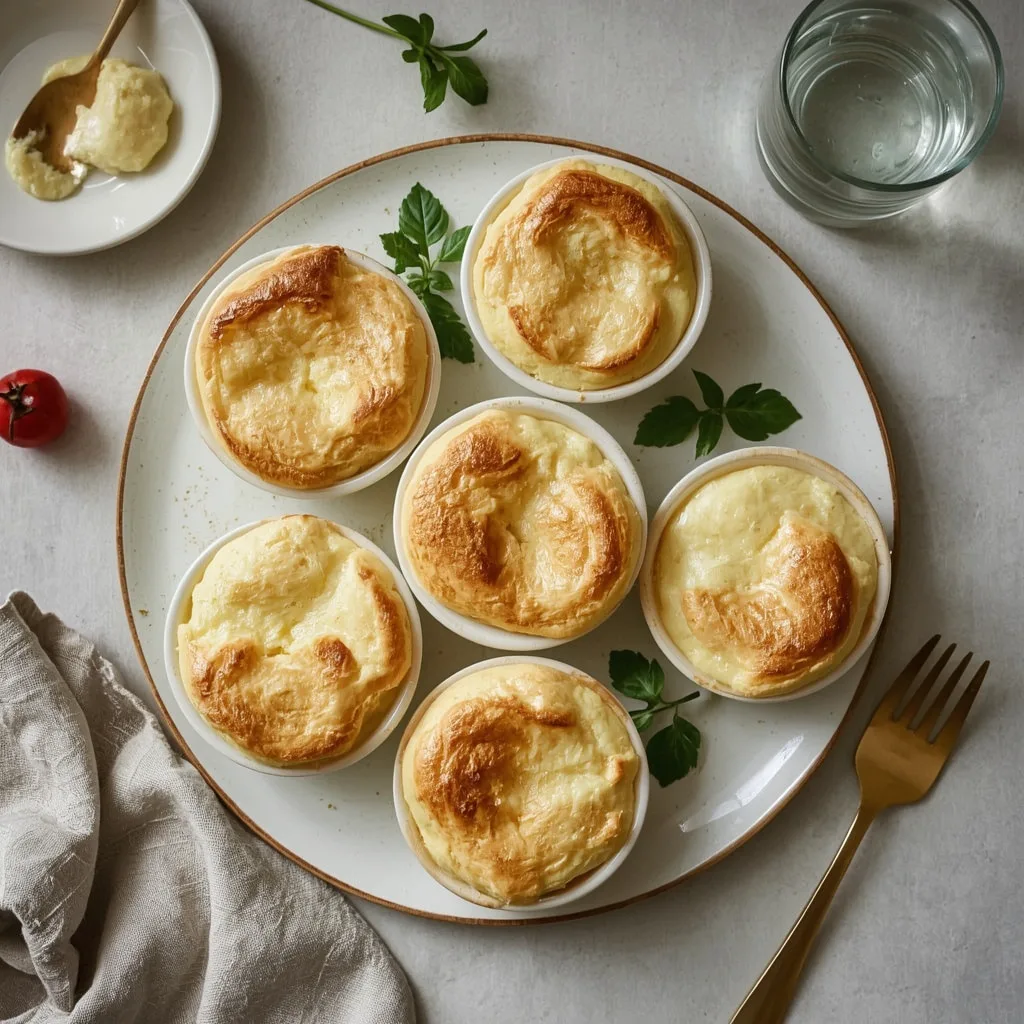
- Add the cream and cheese — pour the cream around the bases, stopping about a third of the way up the sides. Pouring over the tops would wash away the crust. Scatter the 30g coarsely grated Cheddar over and bake for 15 to 18 minutes until puffed and bubbling, with the cream thickened at the edges.
- Rest and serve — stand 5 minutes so the cream settles and they firm enough to lift with a spoon. Scatter the chives over and serve straight away, spooning the reduced cream from the dish over each portion.
What I Got Wrong (And How I Fixed It)
These are the points where a batch can quietly go wrong, usually before it reaches the oven.
- Over-whisked whites — stiff, dry peaks tear through the base and the tops crack in the first bake. Stop at soft, billowy peaks that just droop off the whisk.
- Stirring instead of folding — a stirring motion knocks out the air. Cut down to the bottom with a large metal spoon and sweep up over the top, turning the bowl a quarter each time.
- A browned roux — letting it colour past pale gold carries a toasted flavour into a delicate cheese base. Pull it off the heat the moment it smells nutty.
- Under-seasoned base — the egg whites dilute everything, so a mixture that tastes right in the pan tastes bland later. Taste and adjust before folding.
- Turning out while hot — warm soufflés tear and stick. Ten minutes in the ramekin, then a full 30 minutes on the rack, is not optional.
- Cream poured over the tops — it soaks the crust and you lose the blistered finish. Keep it around the base, one-third up the sides.
Healthier Version of Mary Berry Twice-Baked Cheese Soufflés Recipe
You can trim the richness without wrecking the structure, though expect a slightly less custardy centre.
- Reduce the cream bath — use 120ml double cream topped up with 120ml milk. Saves fat while still giving a sauce.
- Swap half the Cheddar — replace 50g of the mature Cheddar with a strong reduced-fat Cheddar. Keeps the savoury hit with less saturated fat.
- Use semi-skimmed milk — in place of the 240ml whole milk. The sauce is slightly thinner but still sets.
- Lose the top cheese — leave out the 30g coarsely grated Cheddar. You get less crust, but a lighter dish overall.
- Add bulk with vegetables — fold 3 tbsp of finely chopped, well-drained cooked spinach into the base. Extra fibre with no effect on the rise.
Ingredient Substitutions for Mary Berry Twice-Baked Cheese Soufflés Recipe
Most swaps here are simple, but a couple will change the texture noticeably.
- Parmigiano-Reggiano (2 tbsp / 10g) → Pecorino Romano (2 tbsp / 10g) — sharper and saltier, so dust lightly. Works well for the ramekins.
- Mature Cheddar (100g) → Gruyère (100g) — nuttier and melts beautifully. Grate finely so it blends into the sauce.
- Dijon mustard (1 tsp) → English mustard (1/2 tsp) — much hotter, so halve it to keep the balance.
- Double cream (160ml) → crème fraîche (160ml) — thicker, with a gentle tang. Loosen with an extra 2 tbsp milk so it pools properly.
- Whole milk (240ml) → oat milk (240ml) — works for a dairy-free-adjacent base, though it will taste less rich.
- Fresh chives (1 tbsp) → flat-leaf parsley (1 tbsp) — a cleaner, less oniony finish. Chop just before serving.
Pairing Ideas: What to Serve With Mary Berry Twice-Baked Cheese Soufflés Recipe
Savoury and rich, so keep the sides sharp, green or crisp.
- Dressed bitter leaves — chicory or watercress with lemon and olive oil cuts straight through the cream.
- Tomato and shallot salad — ripe tomatoes, thinly sliced shallot, red wine vinegar and salt. Fresh contrast, no cooking.
- Warm crusty baguette — for mopping the reduced cream from the dish, which would otherwise be a loss.
- Steamed green beans — simply buttered and seasoned. A clean vegetable alongside something this rich.
- Sparkling apple juice — chilled, in place of anything heavier. The acidity resets the palate between bites.
- Roast cherry tomatoes — blistered on the vine at 200°C/180°C fan/gas 6 for 12 minutes. Sweetness against the sharp cheese.
Expert Tips to Make Perfect Mary Berry Twice-Baked Cheese Soufflés Recipe
Small details, but each one shows on the plate.
- Brush butter upwards — vertical strokes from base to rim give the rising mixture a track to climb. Sideways brushing leaves it slipping.
- Room-temperature whites — they whip faster and hold air better. Separate them while cold, then let them sit 20 minutes.
- Use a clean dry bowl — a trace of yolk or grease stops the whites aerating. Wipe with vinegar if in doubt.
- Grate the Cheddar finely — coarse shreds melt unevenly and leave a grainy base. Microplane it if you have one.
- Rest before serving — five minutes lets the cream settle and the structure firm. Serving straight from the oven collapses on the spoon.
- Chill after the first bake — up to 24 hours covered in the fridge. Add 3 to 4 minutes to the second bake if going straight from cold.
- Never hold the folded mix — once the whites are in, bake immediately. The air starts leaving within minutes.
Creative Ways to Customize Mary Berry Twice-Baked Cheese Soufflés Recipe
The base is a good canvas, and most additions sit happily alongside the cheese.
- Herbed version — stir 1 tbsp finely chopped thyme or tarragon into the cheese base for a fragrant lift.
- Wholegrain mustard twist — use 1 tsp wholegrain instead of Dijon for visible seeds and a gentler heat.
- Smoked paprika finish — dust a pinch over the cream before the second bake for a warm, smoky top note.
- Blue cheese blend — replace 30g of the Cheddar with crumbled Stilton. Bold, but it works with the chives.
- Caramelised onion layer — spoon 1 tsp of cooled, soft onions into each ramekin before filling. Sweetness against the sharp cheese.
- Individual gratin dishes — bake the second stage in smaller dishes for more crisp cream edges per portion.
Storing Mary Berry Twice-Baked Cheese Soufflés Recipe the Right Way
Everything hinges on which bake you have reached.
- Fridge, after the first bake — cool completely, then cover in a single layer with cling film. Keeps for up to 24 hours.
- Freezer, first bake only — open-freeze on a tray, then wrap individually in cling film and foil. Good for up to 1 month; defrost overnight in the fridge.
- Second-bake leftovers — keep 2 days in the fridge, covered. Texture will be denser on reheating, so do not expect the first-day finish.
- Never freeze twice-baked — the cream splits and the custard goes watery. Freeze only the first-bake stage.
- Avoid holding the raw mix — once the whites are folded in, it must go straight into the oven.
How to Reheating Mary Berry Twice-Baked Cheese Soufflés Recipe (If Needed)
Only the second-bake leftovers ever need reheating, and gentle heat is the rule.
- Oven, covered — 180°C/160°C fan/gas 4 for 10 to 12 minutes, until piping hot. Cover the dish loosely with foil so the tops do not dry out.
- Microwave, short bursts — medium power in 30-second intervals. Fast but the crust softens quickly.
- Air fryer — 160°C for 6 to 8 minutes. Watch closely; the tops catch fast in a small air fryer.
- Straight from the fridge — for unbaked first-bake soufflés, do the second bake cold and add 3 to 4 minutes.
Nutritional Breakdown (per serving)
Based on 1 serving = 1 soufflé with its share of the cream, out of 4 total.
- Calories — 508
- Protein — 20g
- Fat — 42g
- Saturated Fat — about 25g
- Carbohydrates — 13g
- Fibre — 0g
- Sugar — 5g
- Sodium — 707mg
- Cholesterol — around 265mg
FAQs
Can I prepare Mary Berry Twice-Baked Cheese Soufflés Recipe ahead of time?
Yes, and it is the main reason to make them. Take them through the first bake, cool fully and turn out, then refrigerate covered for up to 24 hours before the second bake.
Can you freeze Mary Berry Twice-Baked Cheese Soufflés Recipe?
First-bake soufflés freeze well for up to 1 month. Firm them on a tray, wrap individually, and defrost overnight in the fridge before baking. Never freeze after the second bake.
Why did my soufflés crack or collapse?
Usually over-whisked egg whites or over-folding. Stiff peaks and heavy mixing knock out the air, so aim for soft, billowy peaks and stop as soon as a few streaks of white remain.
Can I make one large soufflé instead of four small ones?
It is possible, but the timing changes and the portions are harder to serve. Individual ramekins give a better crust-to-custard ratio and turn out far more reliably.
What is the best cheese to use?
Mature sharp Cheddar for the base, finely grated so it melts smoothly, plus a little Parmigiano for dusting the ramekins. Gruyère is a good alternative if you want a nuttier flavour.
How long do leftovers last?
Two days in the fridge, covered. Reheat at 180°C/160°C fan/gas 4 for 10 to 12 minutes until piping hot, though the centre will be denser than when freshly baked.
Try These Recipes
Wrapping It Up
Two bakes and a cream bath turn a fussy French classic into something you can prep the day before and finish in under 20 minutes. Follow this Mary Berry Twice-Baked Cheese Soufflés Recipe once and the timing becomes second nature. Give it a go for your next dinner party — the crisp top and soft custard centre do the impressing for you.
PrintMary Berry Twice-Baked Cheese Soufflés
Light-as-air Cheddar soufflés that are baked, cooled, turned out and then given a second bake in seasoned cream until puffed and golden. The first bake sets the structure, cooling makes them shrink cleanly from the ramekin, and the second bake warms them through while the cream thickens into a savoury sauce. The result is a soufflé with a crisp golden top and a soft, custardy centre that can be prepared hours ahead with no last-minute panic.
- Prep Time: 25
- Cook Time: 35
- Total Time: 75
- Yield: 4 1x
- Category: Main Course
- Method: Baking
- Cuisine: French
Ingredients
For the soufflés
- 15g unsalted butter, at room temperature, for greasing the ramekins
- 10g Parmesan, finely grated, for dusting the ramekins
- 30g unsalted butter, for the sauce
- 30g plain flour
- 240ml whole milk
- 1 tsp Dijon mustard
- ¼ tsp fine sea salt
- Pinch of freshly ground black pepper
- Pinch of cayenne pepper
- 100g mature Cheddar, finely grated
- 4 large eggs, separated, whites at room temperature, yolks lightly beaten
For the second bake
- 160ml double cream
- 120ml whole milk
- ¼ tsp fine sea salt
- 30g mature Cheddar, coarsely grated
- 1 tbsp finely chopped fresh chives
Instructions
- Preheat the oven to 200°C/180°C fan/gas 6 with a shelf just below the middle. Brush four 200ml ramekins generously with the soft butter using upward strokes from base to rim, which gives the rising soufflé something to climb. Dust each ramekin with the finely grated Parmesan, turning and tapping to coat the base and sides evenly, then tip out any excess.
- Melt the 30g butter in a medium heavy-based pan over a medium-low heat until it foams, about 1 minute. Add the flour all at once and whisk continuously for 1 minute, until the roux is pale gold and smells nutty rather than raw. Do not let it brown, as a dark roux will carry a toasted flavour into the delicate cheese sauce.
- Pour in the 240ml milk in three goes, whisking hard after each so no lumps form. It will look lumpy at first, then smooth out. Cook over a medium heat, whisking constantly, for 3–4 minutes, until it is as thick as custard and the whisk leaves a clean trail across the base of the pan.
- Take the pan off the heat and stir in the mustard, ¼ tsp salt, black pepper and cayenne, then add the 100g finely grated Cheddar and stir until completely melted and glossy. Taste and adjust the seasoning; the mixture should be well seasoned, as the egg whites will dilute it. Scrape into a large bowl and leave to cool for 5 minutes, until just warm.
- Whisk the egg yolks into the warm cheese sauce a third at a time until fully combined; adding them gradually stops them curdling. The mixture should be smooth, thick and glossy.
- In a spotlessly clean, dry bowl, whisk the egg whites with an electric whisk on medium speed for 2–3 minutes, until they form soft peaks that just hold their shape and droop slightly when the whisk is lifted. Stop there; stiff, dry peaks will make the soufflés crack and collapse.
- Fold a third of the whites into the cheese sauce with a large metal spoon, using a cutting and turning motion rather than stirring, to loosen the mixture. Fold in the remaining whites in two goes, cutting down to the bottom of the bowl and sweeping up over the top, until only a few streaks of white remain; under-folding is fine, over-mixing is fatal.
- Divide the mixture evenly between the ramekins, filling them almost to the rim. Level the tops, then run your thumb around the inside rim to make a thin 3mm groove. This clean edge gives the soufflés an even, straight rise.
- Stand the ramekins in a roasting tin and pour boiling water into the tin to come halfway up the sides of the ramekins, taking care not to splash the mixture. Bake for 18–20 minutes, until risen about 2.5cm above the rims, deep golden on top and just set, with the faintest wobble when the tin is nudged. If the tops brown too fast, lay a sheet of foil loosely over the tin.
- Lift the ramekins out of the water and leave on a wire rack for 10 minutes, until they shrink slightly from the sides and sink back level with the rim. Turn each one out onto your palm with a gentle tap and set on the rack. Cool completely, at least 30 minutes; they will sink and look unremarkable at this stage, which is exactly right.
- Heat the oven to 200°C/180°C fan/gas 6 again. Butter a shallow ovenproof dish large enough to hold the four soufflés in a single snug layer. Whisk the double cream, 120ml milk and ¼ tsp salt together in a jug. Arrange the soufflés in the dish, domed tops up, with a little space between each.
- Pour the cream mixture around the soufflés, stopping about a third of the way up their sides; pouring it over the tops would wash away the crust. Scatter the coarsely grated Cheddar over the tops and bake for 15–18 minutes, until the soufflés have puffed up again, the cheese is bubbling and the cream has thickened slightly around the edges.
- Leave to stand for 5 minutes so the cream settles and the soufflés firm up enough to lift with a serving spoon. Sprinkle with the chives and serve straight away, spooning some of the cream from the dish over each one.
Notes
The soufflés can be baked once and turned out up to 24 hours ahead. Cool completely, then cover with cling film and keep in the fridge in a single layer, or freeze. To freeze, open-freeze the cooled soufflés on a tray until firm, then wrap individually in cling film and foil; they keep for up to 1 month. Defrost overnight in the fridge before the second bake. Do not freeze after the second bake. Do the second bake straight from the fridge, adding 3–4 minutes to the baking time, or from defrosted at 200°C/180°C fan/gas 6 for 20–22 minutes. Leftovers from the second bake keep for 2 days in the fridge and reheat, covered, at 180°C/160°C fan/gas 4 for 10–12 minutes until piping hot, though the texture will be denser. Once the egg whites are folded in, bake the mixture straight away.
Nutrition
- Calories: 508
- Sugar: 5g
- Sodium: 707mg
- Unsaturated Fat: 24g
- Carbohydrates: 13g
- Fiber: 0g
- Protein: 20g
- Cholesterol: 299mg
Keywords: mary berry twice baked cheese souffle, twice baked cheese souffle, cheese souffle recipe, make ahead souffle, twice baked souffle, cheddar souffle, cheese souffle starter, baked souffle ramekins, dinner party starter, Christmas starter, vegetarian starter, cream baked souffle


