
 Ekani Ella
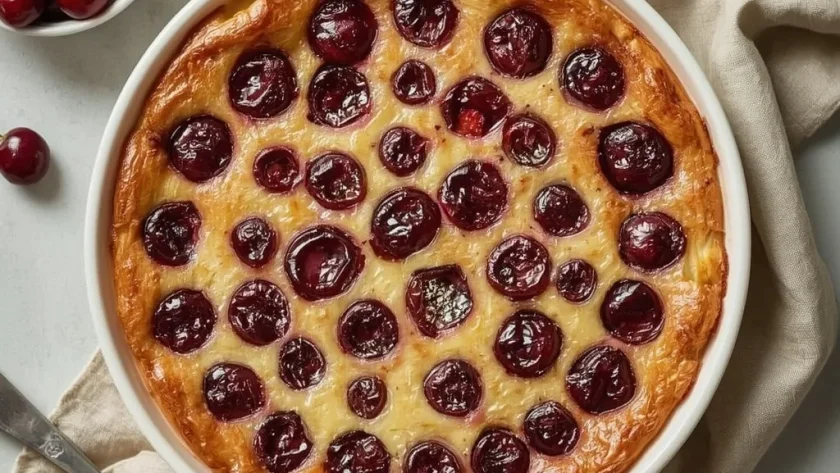
A Mary Berry Cherry Clafoutis Recipe is a French baked custard with whole sweet cherries suspended in a silky set batter, puffed and golden at the edges. Eggs, flour, milk and cream do all the work here — there is no pastry and no raising agent.
Fifty-five minutes from start to finish, beginner level, and it fits a weekend lunch or a plain midweek pudding when cherries are cheap. The one step worth slowing down for is buttering the dish in upward strokes, because that thin film is what lets the custard climb instead of tear.
What is Mary Berry Cherry Clafoutis Recipe?
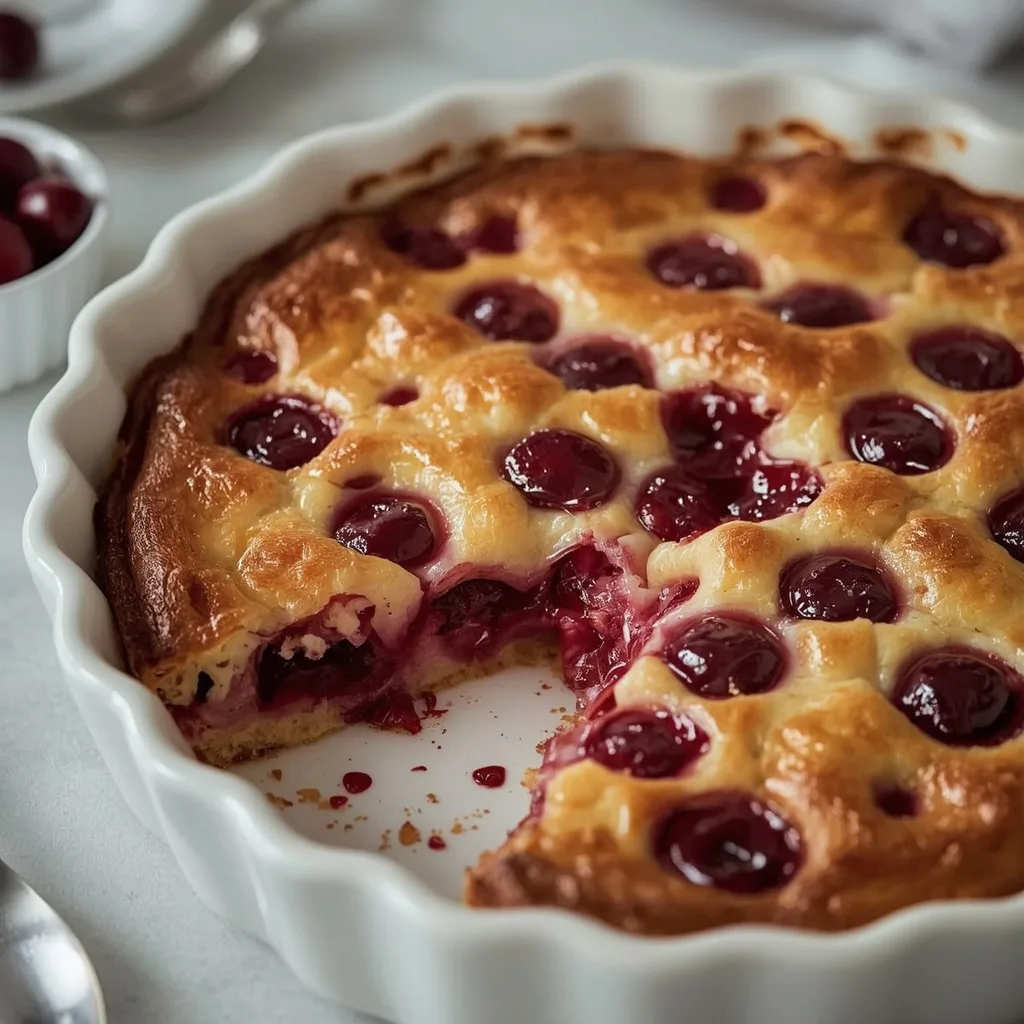
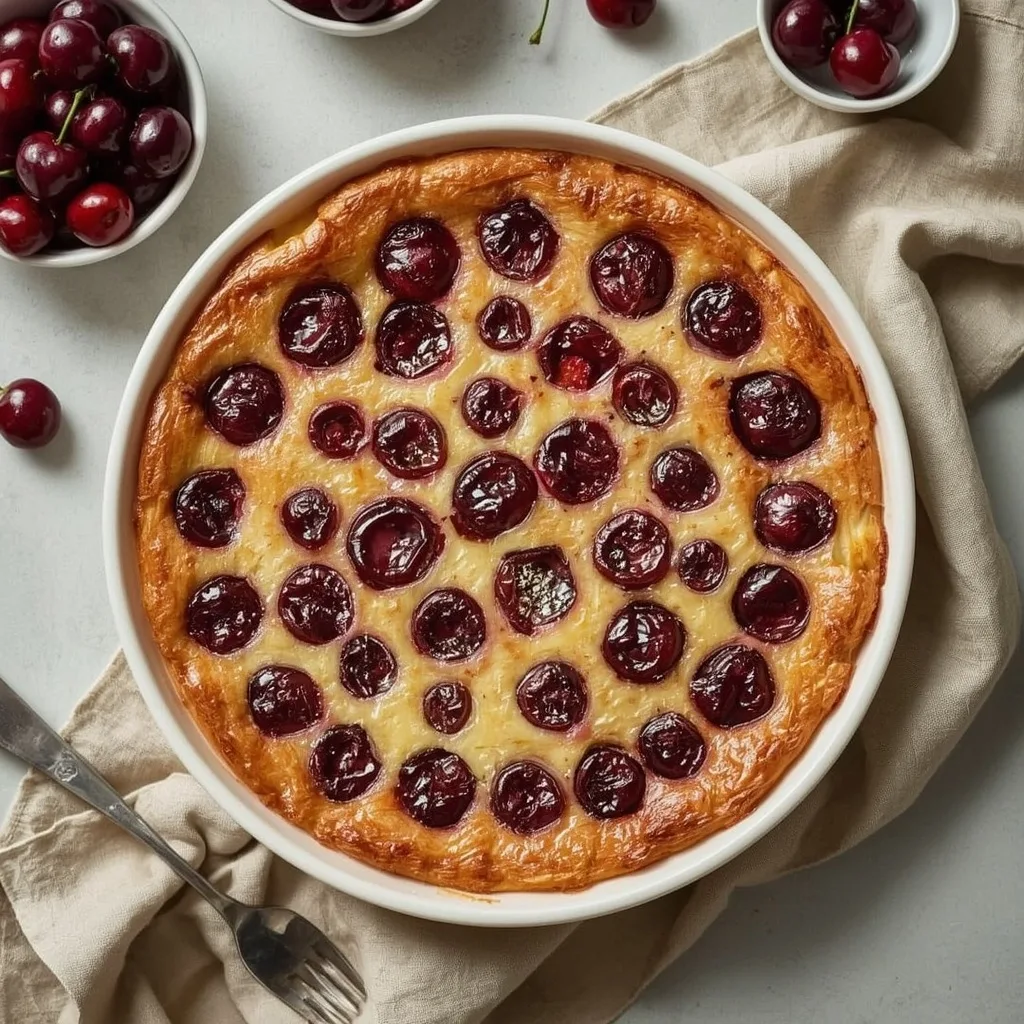
Pitted whole cherries go into a buttered dish, get covered with a thin batter of eggs, sugar, flour, milk and cream, and bake until just set. The rim puffs and browns while the middle stays soft enough to tremble when you nudge the dish. Texture-wise it sits closer to a sweet Yorkshire pudding than a sponge cake — a baked custard with fruit, not a dessert you slice cleanly. It comes from the Limousin region of France and belongs to summer, when cherries are at their peak.
Why This Recipe is Worth Trying
- One dish, no pastry — there is nothing to roll, blind bake or chill, so the whole thing comes together in a single bowl and a single tin.
- Silky set custard — the ratio of whole eggs to milk and cream gives a tender wobble that shop-bought desserts never manage.
- Cherries do the visual work — they sit at the bottom, then rise gently as the batter sets, so the finished dish looks far more effortful than it was.
- Thirty-five minutes in the oven — quick enough for a weeknight, smart enough for guests arriving at seven.
- Everyday ingredients — butter, eggs, flour, sugar, milk and cream, with two extracts for depth. Nothing obscure.
Essential Ingredients to Make Mary Berry Cherry Clafoutis Recipe
Nothing on this list is hard to find, but the quality of two things — the cherries and the vanilla — decides how good the finished dish tastes.
Fruit and Dish Prep
- 2 tbsp (25 g) unsalted butter, at room temperature — used twice: once to grease the dish and once, melted, to brush over it. Soft butter spreads in upward strokes far better than cold.
- 1 lb 2 oz (500 g) fresh sweet cherries, stems removed and pitted (about 3 cups) — look for firm, dark, glossy fruit with green stems still attached. Soft or wrinkled cherries will bleed and water down the batter.
The Custard Base
- 3 large eggs, at room temperature — they whip to a much fuller ribbon when warm, which is where the lightness comes from.
- 1/3 cup plus 1 tbsp (75 g) caster sugar — finer than granulated, so it dissolves into the eggs without gritty bits.
- 1/2 cup plus 1 tbsp (75 g) all-purpose flour — plain flour only. Sift it; lumps sink and leave a rubbery band at the base.
- 1/4 tsp fine sea salt — a small amount that stops the custard tasting flat against all that sugar.
- 3/4 cup plus 1 tbsp (200 ml) whole milk — full-fat matters. Skim milk gives a thinner, less creamy set.
- 3/4 cup plus 1 tbsp (200 ml) heavy cream — this is what turns the batter from pancake-thin into something rich and spoonable.
Flavourings and Finishing
- 1 tsp vanilla extract — real extract, not flavouring. It rounds out the egg and cream.
- 1/4 tsp almond extract — a tiny amount, but it echoes the cherry stones and makes the fruit taste more like itself. Easy to overdo.
- 1 tbsp (8 g) powdered sugar, for dusting — applied through a sieve at the last minute so it stays dry and doesn’t dissolve into the surface.
Handy Kitchen Tools for Best Results
You probably own most of these already, and none of them are expensive.
- 9-inch (23 cm) round shallow ceramic or glass dish — about 2 inches deep. A metal tin conducts heat too fast and sets the edges before the middle catches up.
- Balloon whisk — the open shape pulls air into the eggs much faster than a fork or a hand mixer on low.
- Fine sieve — for sifting the flour and salt, and again for straining a lumpy batter. Doubles as the sugar duster.
- Cherry pitter — saves your thumbs if you are doing 500 g. A small paring knife and a thumb work perfectly well otherwise.
- Probe thermometer — optional, but it turns “is it done?” into a straight yes or no at 175°F / 80°C.
Step-by-Step Guide to Making Mary Berry Cherry Clafoutis Recipe
Twelve short steps, and only two of them really affect the outcome — the greasing and the moment you take it out of the oven.
- Heat the oven and butter the dish — rack in the middle, 350°F / 180°C. Use 1 tbsp of the soft butter in upward strokes from the base to just above the batter line.
- Pit the cherries — work over a bowl to catch the juice and keep the fruit whole. Pat them dry on paper towels so they don’t water down the batter.
- Sift the dry ingredients — flour and fine sea salt together onto parchment or into a small bowl. Skipping this leaves lumps that sink.
- Whisk eggs and sugar to a ribbon — 3 to 4 minutes until pale, glossy and thick enough to leave a brief trail when the whisk lifts.
- Fold in the flour — add it all at once and whisk gently for about 30 seconds, just until no dry streaks remain. Stop there.
- Loosen with milk and cream — stream the milk in while whisking, then the cream, then both extracts. Aim for the consistency of single cream.
- Rest the batter — 15 minutes at room temperature. The flour hydrates and the bubbles settle, giving a smoother top.
- Build the dish — melt the remaining 1 tbsp butter and brush the base and sides again. Scatter the cherries in one slightly overlapping layer.
- Pour the batter over the fruit — slowly, from a low height, so the cherries stay put. Do not stir afterwards.
- Bake until just set — 30 to 35 minutes, until puffed and deep golden at the rim with a wobble in the centre only. Keep the door shut before 28 minutes or the rise collapses.
- Cool before serving — 15 to 20 minutes on a wire rack. It will sink slightly; that is correct, not a failure.
- Dust and serve — powdered sugar through a sieve held high, then scoop with a wide spoon so each portion gets custard and cherries together.
What I Got Wrong (And How I Fixed It)
Here is what tripped me up the first few times, in the order it usually happens.
- Greasing only the flat base — the custard then grips the sides and tears as it rises. Butter upwards, past the batter line.
- Wet cherries straight from the colander — excess water pools and the set turns patchy. Pat them properly dry.
- Overwhisking after the flour goes in — the gluten develops and you end up with something bready. Thirty seconds, then stop.
- Opening the oven at 20 minutes to peek — the cold air drops the rise and it never recovers. Wait until at least 28 minutes.
- Skipping the 15-minute rest — the batter looks fine, but the baked result is coarser and more likely to tunnel on top.
- Serving it straight from the oven — scalding hot, the custard tastes of nothing but egg. Warm is where the cherry flavour shows.
Healthier Version of Mary Berry Cherry Clafoutis Recipe
You can lighten this without wrecking the texture, as long as you accept a slightly firmer set.
- Cut the caster sugar back — 55 g instead of 75 g works because the cherries carry most of the sweetness. Expect a marginally denser custard.
- Trade some cream for milk — use 250 ml milk and 150 ml cream in place of the equal split, which drops the fat noticeably while keeping the custard soft.
- Add wholemeal flour — swap 2 tbsp of the all-purpose flour for wholemeal for extra fibre. Sift it twice to keep the crumb fine.
- Skip the dusting — leaving off the 8 g of powdered sugar saves a little sugar and lets the fruit read more clearly.
- Serve with Greek yogurt — a spoonful of 0% fat yogurt instead of pouring cream cuts calories without losing the cool contrast.
Ingredient Substitutions for Mary Berry Cherry Clafoutis Recipe
Most of these swaps are ones I have tested, and a couple change the character of the dish in a good way.
- Fresh sweet cherries (500 g) → frozen cherries (500 g) — use them straight from frozen, do not thaw, and add 5 minutes to the bake. Expect a little more juice in the dish.
- Whole milk (200 ml) → semi-skimmed or oat milk (200 ml) — both work; oat milk gives a slightly nuttier finish and the set stays soft.
- Heavy cream (200 ml) → evaporated milk (200 ml) — lighter but still rich, with a faint caramel note that suits the cherries.
- Caster sugar (75 g) → golden caster sugar (75 g) — same weight, same behaviour in the whisk, just a warmer, faintly toffee-ish flavour.
- Almond extract (1/4 tsp) → vanilla extract (1/4 tsp) — for anyone avoiding nuts. You lose the cherry-stone depth, so add a pinch of salt to compensate.
- All-purpose flour (75 g) → gluten-free plain blend (75 g) — use a blend with xanthan gum and whisk the batter a touch longer to avoid a grainy set.
Pairing Ideas: What to Serve With Mary Berry Cherry Clafoutis Recipe
This is a soft, warm dessert, so anything cold and clean on the side does it favours.
- Cold pouring cream — a jug on the table, unwhipped, is the classic and still the best. The coolness cuts the richness.
- Vanilla ice cream — one scoop per portion, and only if the clafoutis is still warm enough to melt it slightly at the edge.
- A pot of strong tea — the tannin resets your palate between spoonfuls, which matters with a custard this sweet.
- Crème fraîche — thicker than cream with a gentle tang that stops the whole thing feeling one-note.
- Toasted flaked almonds — a scattered spoonful adds crunch the soft custard otherwise lacks, and echoes the almond extract.
- Cloudy apple juice, well chilled — an alcohol-free pour with enough acidity to freshen the finish.
Expert Tips to Make Perfect Mary Berry Cherry Clafoutis Recipe
These are the small things that separate a good clafoutis from a rubbery one.
- Butter in upward strokes, not circles — the vertical film gives the rising custard something to climb. Circular greasing leaves it smooth and it slides back down.
- Weigh the flour on a scale — a heaped cup can add 20 g, which is enough to turn delicate into dense.
- Room temperature eggs whip faster — take them out 30 minutes ahead, or sit them in warm water for 10 minutes.
- Pat the cherries bone dry — juice on the surface of the fruit dilutes the batter directly beneath it and creates soggy pockets.
- Watch the wobble, not the clock — a centre that moves as one mass when you nudge the rack is set. A centre that ripples is not.
- Dust the sugar at the last second — do it earlier and it dissolves into the surface, leaving a damp sheen instead of a veil.
- Stay shallow with the dish — 2 inches deep is the sweet spot. A deep tin means the middle sets before the edges brown.
Creative Ways to Customize Mary Berry Cherry Clafoutis Recipe
Once the base method is in your head, this is a very easy dessert to bend in other directions.
- Swap the fruit entirely — halved apricots, plums or nectarines work weight for weight at 500 g. Stone fruit releases more juice, so pat it dry first.
- Add lemon zest — the zest of one lemon into the batter lifts the whole thing and sharpens the cherry flavour.
- Scatter dark chocolate — 50 g of chopped dark chocolate over the cherries before the batter goes in. It sinks slightly and stays soft.
- Warm spice, lightly — a pinch of ground cinnamon or nutmeg in the flour suits an autumn version made with plums.
- Individual ramekins — divide between six buttered ramekins and start checking at 20 minutes, since smaller volumes set faster.
- Almond topping — a handful of flaked almonds scattered over the batter just before baking gives a crisp lid.
Storing Mary Berry Cherry Clafoutis Recipe the Right Way
Honestly, this is a same-day dessert. But if you have leftovers, they keep better than you would expect.
- Fridge, covered — press cling film directly onto the surface to stop a skin forming, then keep for up to 3 days.
- Freezer — up to 1 month in a sealed container, though the custard will weep and lose its airiness on thawing. Thaw overnight in the fridge.
- Short counter rest — a couple of hours at room temperature is fine, but get it into the fridge within two hours of cooling.
- Portioned slices — cut into wedges and store in a single layer in a lidded glass container so they don’t squash each other.
- Tight lid over foil — foil alone lets the custard dry at the edges. A lid keeps the surface soft.
How to Reheat Mary Berry Cherry Clafoutis Recipe (If Needed)
Cold, it sets firm like a baked custard tart, and plenty of people prefer it that way. If you want it warm again, gentle heat is the rule.
- Oven, loosely covered — 300°F / 150°C for 10 to 12 minutes. Foil stops the top drying out while the middle warms through.
- Air fryer — 300°F / 150°C for 5 to 6 minutes in a heatproof dish that fits. Check at 4 minutes; the edges catch quickly.
- No reheat at all — straight from the fridge with a spoon is legitimate. The custard is firmer and the cherry flavour is actually sharper cold.
A microwave is the one method to avoid. It heats unevenly, turns the edges rubbery and leaves the centre lukewarm.
Nutritional Breakdown (per serving)
Based on 1 serving = 1 portion out of 4 total.
- Calories — 530
- Protein — about 10g
- Fat — 29g
- Carbohydrates — around 59g
- Fiber — 3g Print
- Prep Time: 20
- Cook Time: 35
- Total Time: 55
- Yield: 4 1x
- Category: Dessert
- Method: Baking
- Cuisine: French
- 2 tbsp (25 g) unsalted butter, at room temperature, for greasing the dish
- 1 lb 2 oz (500 g) fresh sweet cherries, stems removed and pitted (about 3 cups)
- 1/3 cup plus 1 tbsp (75 g) caster sugar
- 3 large eggs, at room temperature
- 1/2 cup plus 1 tbsp (75 g) all-purpose flour
- 1/4 tsp fine sea salt
- 1 tsp vanilla extract
- 1/4 tsp almond extract
- 3/4 cup plus 1 tbsp (200 ml) whole milk
- 3/4 cup plus 1 tbsp (200 ml) heavy cream
- 1 tbsp (8 g) powdered sugar, for dusting
- Position a rack in the middle of the oven and preheat to 350°F / 180°C. Grease a 9-inch (23 cm) round shallow ceramic or glass baking dish, about 2 inches deep, using 1 tbsp of the softened butter. Work the butter in upward strokes from the base to just above the batter line — this thin film is what lets the custard climb and puff rather than stick and tear.
- Pit the cherries over a bowl to catch the juice, keeping the fruit whole. If you have a cherry pitter, use it; otherwise slit each cherry with a small paring knife and flick the stone out with your thumb. Pat the cherries dry on paper towels so they do not water down the batter, and set them aside.
- Sift the flour and fine sea salt together onto a sheet of parchment or into a small bowl. Sifting is not optional here — it breaks up lumps that would otherwise sink to the bottom of the custard and leave a rubbery layer.
- In a large mixing bowl, whisk the eggs and caster sugar with a balloon whisk for 3 to 4 minutes, until the mixture turns pale, glossy and thick enough to leave a brief ribbon trail on the surface when the whisk is lifted. This aeration is what gives clafoutis its lightness.
- Tip the sifted flour and salt into the egg mixture in one go and whisk gently for about 30 seconds, just until no dry streaks remain. Stop as soon as it comes together — overworking the gluten makes the custard tough and bready instead of delicate.
- Slowly stream in the milk, whisking constantly, then the cream, followed by the vanilla and almond extracts. The batter should be the consistency of single cream. If it looks lumpy, strain it through a fine sieve into a jug and press the lumps through with the back of a ladle.
- Let the batter rest at room temperature for 15 minutes. Resting allows the flour to hydrate fully and the bubbles to settle, which gives a smoother, more even set with no tunnelling on top.
- Melt the remaining 1 tbsp butter and brush it over the base and sides of the prepared dish again. Scatter the pitted cherries over the bottom in a single, slightly overlapping layer — they should cover the dish roughly evenly so every portion gets a good share.
- Give the rested batter one gentle stir, then pour it slowly and evenly over the cherries from a low height so the fruit stays in place. Do not stir the dish afterwards; the cherries should stay at the bottom and rise gently as the custard sets.
- Bake for 30 to 35 minutes, until the clafoutis is puffed, deep golden at the rim and set with a distinct wobble in the centre only. If you want certainty, a probe thermometer inserted in the middle should read 175°F / 80°C. Don’t open the oven before 28 minutes or the rise can collapse.
- Remove from the oven and cool on a wire rack for 15 to 20 minutes. It will sink slightly and settle as it cools — this is normal and correct, not a failure. Serve warm, not hot, or at room temperature.
- Dust generously with powdered sugar through a small sieve just before serving, holding the sieve high so the sugar falls in an even veil. Scoop with a wide spoon so each portion gets custard and cherries together; serve with a jug of cold pouring cream on the side if you like.
- Calories: 530
- Sugar: 41g
- Sodium: 242mg
- Unsaturated Fat: 17g
- Carbohydrates: 59g
- Fiber: 3g
- Protein: 10g
- Cholesterol: 225mg
Mary Berry Cherry Clafoutis
A proper French clafoutis in Mary Berry’s simple style: whole sweet cherries suspended in a silky set custard, puffed and golden at the edges with a soft, trembling centre. It bakes in one dish in about half an hour and is best served just warm, dusted with icing sugar. Rustic, elegant and far easier than it looks.
Ingredients
Instructions
Notes
Best eaten the day it is made, while the custard is still soft. Leftovers keep covered in the refrigerator for up to 3 days — press cling film directly onto the surface to stop a skin forming. Reheat, loosely covered with foil, in a 300°F / 150°C oven for 10 to 12 minutes, or eat it cold straight from the fridge, when it sets firmer like a baked custard tart. Freezing is possible for up to 1 month in a sealed container, but the custard will weep and lose its airy texture on thawing; thaw overnight in the refrigerator and reheat as above. Clafoutis is not suitable for reheating in a microwave, which turns the edges rubbery. If using frozen cherries, do not thaw them first, and add 5 minutes to the bake. Stone fruit such as halved apricots, plums or nectarines can replace the cherries weight for weight.
Nutrition
Keywords: mary berry cherry clafoutis, cherry clafoutis, clafoutis recipe, French cherry dessert, clafoutis aux cerises, baked custard dessert, fresh cherry recipe, easy French dessert, summer dessert, Mary Berry dessert, cherry batter pudding, one dish dessert


