
 Ekani Ella
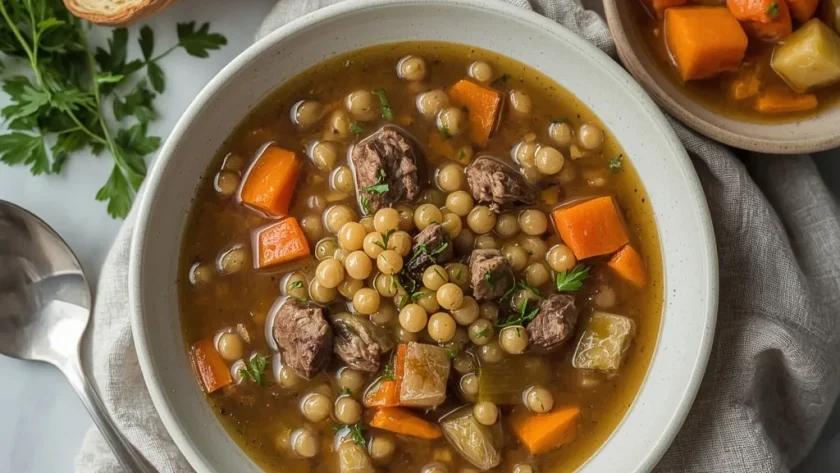
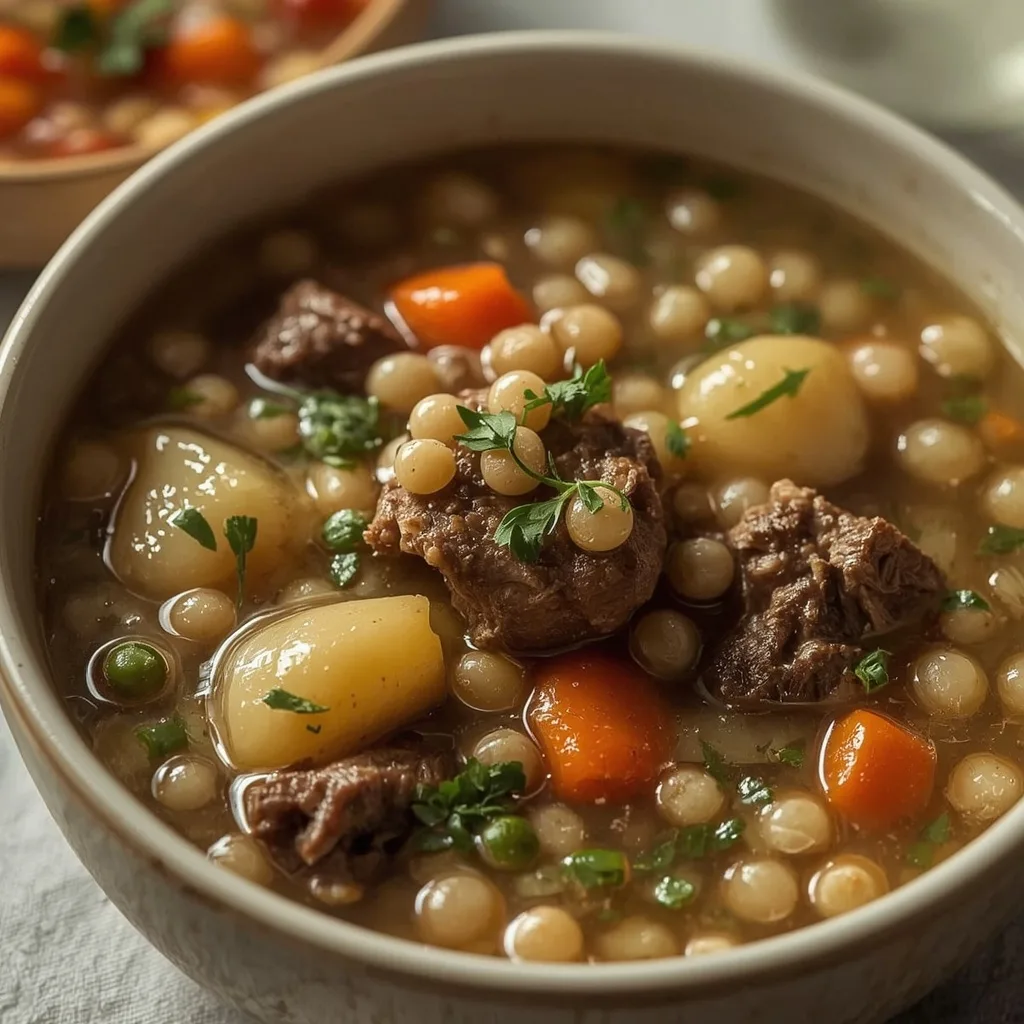
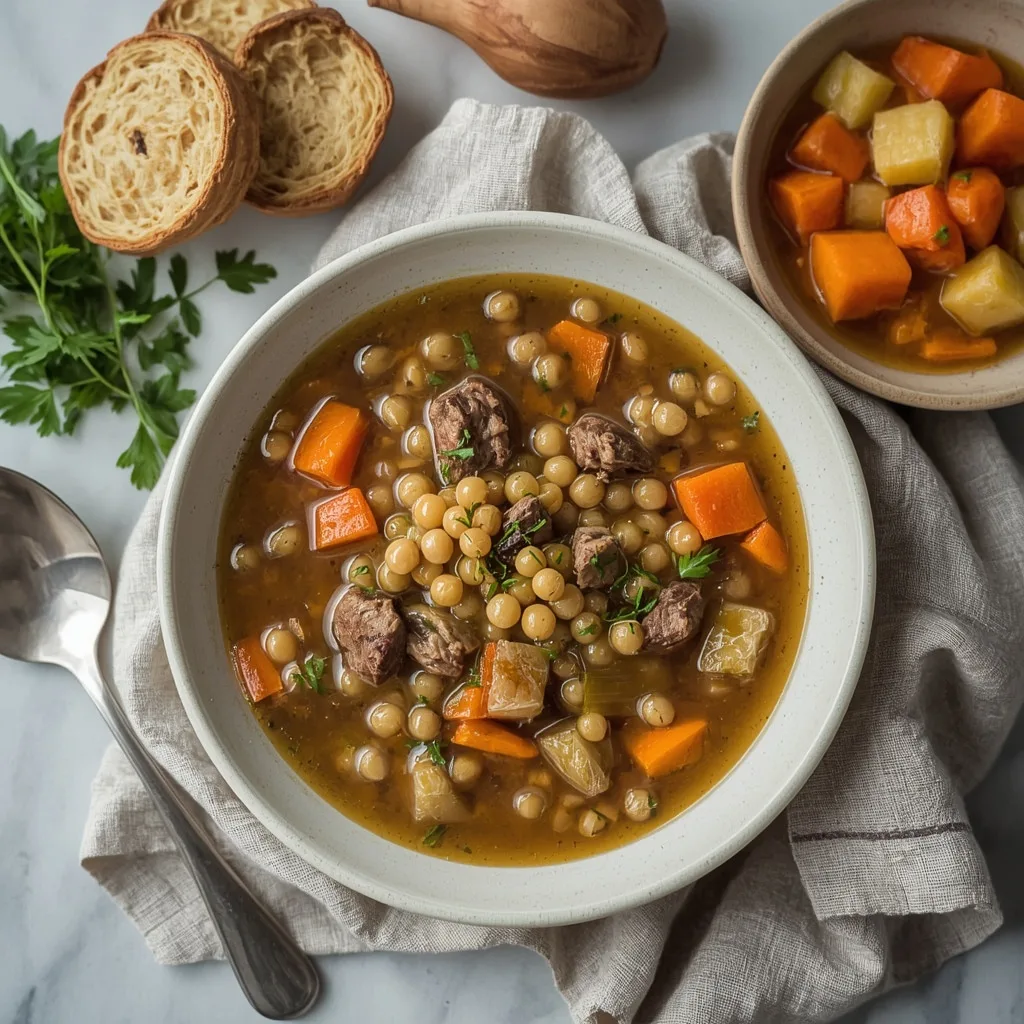
This Mary Berry Scotch Broth Recipe is a deeply savory traditional Scottish soup that combines tender lamb, nutty pearl barley, split peas, and a sweet root vegetable base. The long, gentle simmer creates a naturally thickened broth with a velvety texture and a clean, earthy flavor from leek, rutabaga, and thyme. It is the kind of bowl that warms you from the inside out on a cold day.
Total time from start to finish is 115 minutes — 25 minutes of prep and 90 minutes of gentle simmering. This is an intermediate recipe, mostly because searing the lamb properly and getting the simmer just right takes a little attention. It is perfect for a slow weekend lunch or a make-ahead dinner when the weather turns chilly.
What is Mary Berry Scotch Broth Recipe?
This is a classic Scottish barley soup that relies on lamb shoulder, root vegetables, pearl barley, and yellow split peas simmered slowly on the stovetop. The result is a thick, almost porridge-like broth with a savory, slightly sweet backbone from the onion, leek, carrot, and rutabaga. The pearl barley gives it a chewy bite, while the split peas break down and help thicken the liquid naturally. It is a traditional cold-weather dish that has fed Scottish families for generations.
Why This Recipe is Worth Trying
Here are five reasons this bowl earns a permanent spot in my rotation.
- Deep, slow-built flavor — Searing the lamb and sautéing the vegetables before adding stock creates layers of savory richness you cannot get from a quick boil.
- Naturally thick and satisfying — The pearl barley and split peas release starch as they simmer, turning a simple broth into a hearty, meal-worthy soup without flour or cream.
- One pot, minimal fuss — Everything cooks in a single Dutch oven, so there is less washing up and more time to enjoy the aroma.
- Budget-friendly cuts shine here — Lamb shoulder is affordable and becomes meltingly tender with slow cooking, making this a smart use of an inexpensive ingredient.
- Freezer-friendly and versatile — The soup holds up beautifully in the fridge or freezer, so you can make a big batch and reheat portions for easy lunches.
Essential Ingredients to Make Mary Berry Scotch Broth Recipe
These ingredients build the classic base, sweetness, and body of the soup. Most are pantry or fridge staples once you have the lamb and barley.
Meat and Aromatics
- 1 tablespoon unsalted butter — Searing the lamb in butter adds a rich, nutty base; salted butter works if you reduce the added salt later.
- 1 pound boneless lamb shoulder, trimmed of excess fat and cut into 1/2-inch cubes — Shoulder stays tender during the long simmer; avoid leaner leg meat, which can dry out.
- 1 medium yellow onion, finely diced — Adds sweetness and body as it softens; a white onion works in a pinch.
- 1 medium leek, white and pale green parts only, halved lengthwise and thinly sliced — Leek gives a gentle oniony note without overpowering; rinse well to remove grit.
Vegetables
- 2 medium carrots, peeled and diced into 1/4-inch pieces — Small dice lets them soften evenly and blend into the broth.
- 2 stalks celery, diced into 1/4-inch pieces — Adds a clean, savory freshness; celery leaves can be chopped in for extra flavor if you like.
- 1/2 small rutabaga (swede), peeled and diced into 1/4-inch pieces (about 1 cup) — Rutabaga brings a sweet, earthy depth that balances the lamb; turnip is a close stand-in.
- 1 medium russet potato, peeled and cut into 1/2-inch dice — Russets break down slightly and help thicken the broth; waxy potatoes hold their shape but do not thicken as well.
Grains and Legumes
- 1/2 cup pearl barley, rinsed — Pearl barley gives chewiness and releases starch for a velvety texture; do not skip rinsing to remove dust.
- 1/4 cup dried yellow split peas, rinsed and picked over — Split peas melt into the liquid and add creaminess plus protein; check for small stones before adding.
Liquid and Seasonings
- 6 cups low-sodium chicken stock or lamb stock — Lamb stock deepens the meatiness, but good chicken stock works well too; low sodium lets you control the final salt.
- 1 bay leaf — Adds a subtle herbal backbone; remove it before serving.
- 1 teaspoon fresh thyme leaves, chopped — Fresh thyme is brighter than dried; if using dried, reduce to 1/2 teaspoon.
- 1 teaspoon fine sea salt, divided — You will use half during cooking and adjust the rest at the end based on the stock’s saltiness.
- 1/2 teaspoon freshly ground black pepper — Freshly ground gives better aroma than pre-ground.
- 2 tablespoons fresh flat-leaf parsley, finely chopped — Stir half in at the end and sprinkle the rest on top for freshness and color.
Handy Kitchen Tools for Best Results
You probably have most of these already, but a couple of them make the process much easier.
- Large heavy-bottomed Dutch oven (5-6 quarts) — Even heat distribution prevents scorching during the long simmer; a heavy stockpot also works.
- Sharp chef’s knife — Dicing vegetables to roughly the same size ensures even cooking; a dull knife makes this task tedious.
- Wooden spoon or stiff spatula — Needed to scrape up browned bits from the bottom of the pot, which add depth to the broth.
- Fine-mesh sieve or colander — Useful for rinsing pearl barley and checking split peas for debris.
- Ladle and shallow spoon — A ladle serves the soup, while a shallow spoon helps skim fat from the surface without removing too much liquid.
Step-by-Step Guide to Making Mary Berry Scotch Broth Recipe
Here is the full method, broken down so you can see exactly what happens at each stage. Read through once before starting because the searing and simmering times matter.
- Sear the lamb — Melt 1 tablespoon unsalted butter in a large heavy-bottomed Dutch oven over medium-high heat. When the butter stops foaming, add the lamb cubes in a single layer and sear for 5 to 7 minutes, turning occasionally, until browned on all sides. Avoid crowding the pot or the lamb will steam instead of brown.
- Soften the onion and aromatics — Reduce heat to medium and add the diced onion, sliced leek, carrots, and celery. Cook for 6 to 8 minutes, stirring often, until softened and the onion is translucent with no browning.
- Add the sturdier vegetables — Stir in the rutabaga and potato and cook for 3 to 4 minutes, just until the edges begin to soften. This brief sauté builds a deeper, sweeter base for the broth.
- Combine grains, legumes, and liquid — Add the pearl barley, split peas, stock, bay leaf, thyme, 1/2 teaspoon of the salt, and black pepper. Scrape the bottom of the pot with a wooden spoon to lift any browned bits into the liquid, which adds richness.
- Bring to a boil then reduce — Increase heat to high and bring the liquid to a rolling boil. As soon as it boils, reduce heat to low so the broth maintains a gentle, lazy simmer rather than a hard boil.
- Simmer covered, stirring occasionally — Cover the pot with the lid slightly ajar and simmer for 1 hour, stirring every 20 minutes to prevent the barley and split peas from sticking to the bottom. The broth will reduce slightly and the barley will begin to swell.
- Check the lamb and barley — After 1 hour, test tenderness by pressing a piece of lamb against the side of the pot; it should break apart with light pressure, and the barley should be soft but still have some texture. If needed, continue simmering for 15 to 30 minutes longer.
- Optional oven finish — If you prefer an oven finish, instead of simmering on the stovetop after step 5, cover the Dutch oven and place it in a preheated 325°F / 163°C oven for 1 hour 30 minutes. Remove the pot from the oven and proceed with the next step.
- Remove bay leaf and skim fat — Remove the bay leaf and use a large shallow spoon to skim any excess fat from the surface of the broth. Taste the soup and add the remaining 1/2 teaspoon of salt only if needed, depending on the stock’s saltiness.
- Finish with parsley and rest — Stir in half of the chopped parsley and let the soup rest off the heat for 10 minutes. This resting period allows the flavors to marry and lets the barley release starch, thickening the broth to a rich, slightly sticky consistency.
- Serve hot — Ladle the hot broth into warmed bowls and sprinkle with the remaining parsley. Serve immediately with crusty bread, if you like, though the soup is hearty enough to stand alone.
What I Got Wrong (And How I Fixed It)
Here is what tripped me up the first few times, and the small fixes that made a real difference.
- Crowded lamb pan — Adding too many cubes at once lowered the heat and made the lamb steam instead of brown. Fix it by searing in a single layer with space between pieces, even if that means browning in two batches.
- Boiling too hard — A rolling boil breaks the barley and makes the broth cloudy and starchy. Fix it by reducing the heat until you see only lazy bubbles breaking the surface.
- Undercooking the split peas — Split peas need the full hour to soften completely; a shorter simmer leaves them gritty. Fix it by tasting a few before you stop cooking.
- Salting too early — Adding all the salt at the start can make the final soup overly salty because the stock reduces. Fix it by using only half during cooking and adjusting at the end.
- Skipping the rest time — Serving the soup immediately after simmering leaves it thinner than it should be. Fix it by letting it rest off the heat for 10 minutes so the starch thickens the liquid.
- Forgetting to stir — Barley and split peas sink and stick to the bottom, causing scorching. Fix it by setting a timer to stir every 20 minutes during the simmer.
Healthier Version of Mary Berry Scotch Broth Recipe
Small tweaks can lighten this soup without losing its hearty character.
- Trim the lamb more aggressively — Removing all visible fat before cubing cuts saturated fat and calories; leave a little for flavor, but get rid of the thick white pockets.
- Use a stock with lower sodium — A low-sodium chicken or lamb stock lets you control the salt and keeps the 906 mg per serving from climbing too high.
- Add extra vegetables — Stirring in a handful of chopped kale or spinach during the last 5 minutes adds fiber and vitamins without changing the base flavor.
- Reduce the pearl barley slightly — Dropping the barley from 1/2 cup to 1/3 cup lowers carbohydrates per serving while still giving some chew; the split peas will keep the broth thick.
- Olive oil swap — Replace the butter with 1 tablespoon of extra-virgin olive oil to cut saturated fat while keeping the richness.
Ingredient Substitutions for Mary Berry Scotch Broth Recipe
If you are missing something or need to work around what you have, these swaps keep the soup true to its character.
- Lamb shoulder (1 pound) → Boneless beef chuck (1 pound) — Beef chuck has similar marbling and becomes tender with slow cooking; expect a beefier, less gamey flavor.
- Pearl barley (1/2 cup) → Brown rice or farro (1/2 cup) — Brown rice adds a chewy texture but takes slightly longer to soften, so simmer an extra 15 minutes. Farro cooks in about the same time as barley.
- Yellow split peas (1/4 cup) → Green split peas or red lentils (1/4 cup) — Green split peas behave almost identically; red lentils cook faster and break down completely, so reduce simmer time by 10 minutes.
- Rutabaga (1/2 small, about 1 cup diced) → Turnip or parsnip (1 cup diced) — Turnip is slightly more peppery, parsnip sweeter, but both give the same earthy root depth; adjust salt slightly.
- Leek (1 medium) → Extra onion plus shallot (1 1/2 medium onions + 1 small shallot, thinly sliced) — The combination mimics leek’s gentle sweetness; if you only have onion, add a pinch of sugar.
- Chicken stock (6 cups) → Vegetable stock or beef stock (6 cups) — Vegetable stock makes a lighter, slightly sweeter broth; beef stock adds more savory depth but reduces the lamb’s prominence.
Pairing Ideas: What to Serve With Mary Berry Scotch Broth Recipe
The soup is a meal on its own, but a few sides can round it out nicely for a fuller spread.
- Crusty sourdough or wholemeal bread — A thick slice is ideal for swiping up the last bit of broth and barley from the bowl.
- Traditional Scottish oatcakes — These crunchy oat crackers add a nutty, hearty contrast to the velvety soup and echo the barley’s flavor.
- Sharp mature cheddar — A small wedge on the side brings a salty, tangy note that cuts through the rich lamb broth.
- Simple green salad with lemon dressing — The acidity and crispness lighten each spoonful and balance the soup’s density.
- Pickled beetroot or red cabbage — Sweet-sour pickles provide a bright, clean contrast that refreshes the palate between bites.
- A pot of strong black tea — A warm, non-alcoholic drink that feels right with a Scottish meal and helps cut the richness.
Expert Tips to Make Perfect Mary Berry Scotch Broth Recipe
These small details separate a good pot from a truly memorable one.
- Dry the lamb cubes before searing — Patting them with paper towels removes surface moisture so they brown instead of steam; this step takes 30 seconds and makes a huge difference.
- Dice root vegetables uniformly — Keeping carrots, celery, rutabaga, and potato around the same 1/4-inch size ensures every spoonful has evenly cooked pieces without mushy or hard bits.
- Sauté the vegetables until edges soften, not brown — You want sweetness and aroma, not caramelization; browning here can make the broth taste slightly bitter.
- Use a wooden spoon to scrape the pot bottom — Those browned bits from the lamb are packed with umami, so dissolving them into the stock adds depth no seasoning can replace.
- Stir from the bottom every 20 minutes — Barley and split peas settle quickly; frequent stirring prevents a scorched layer and keeps the texture consistent.
- Taste with the salt only after skimming fat — Fat carries flavor and can mask saltiness; skim first, then taste and season, or you risk over-salting once the fat is gone.
- Let it rest off heat — The 10-minute rest is not optional if you want that rich, slightly sticky consistency; the starch keeps thickening as it cools a little.
Creative Ways to Customize Mary Berry Scotch Broth Recipe
Once you have the base down, these twists give the soup a new personality without losing its soul.
- Add shredded cabbage — Stir in 2 cups of thinly sliced green cabbage during the last 15 minutes for extra bulk and a slight sweetness; it softens but keeps a little bite.
- Swap lamb for smoked turkey — For a lighter, smoky take, replace the lamb with 1 pound of smoked turkey leg or thigh, cut into cubes; simmer for 45 minutes instead of the full hour because the meat is already cooked.
- Spice it with a pinch of cayenne — A tiny pinch added with the pepper gives warmth without heat; start with 1/8 teaspoon and adjust to taste.
- Stir in leafy greens — Add a handful of chopped kale, spinach, or chard during the final 5 minutes; they wilt into the hot broth and bring color plus nutrients.
- Make it root-vegetable heavy — Double the rutabaga and reduce the potato to half, or add a parsnip for a sweeter, more vibrant root flavor.
- Top with crispy onions — A sprinkle of store-bought or homemade crispy fried onions adds crunch and a savory note right before serving.
Storing Mary Berry Scotch Broth Recipe the Right Way
Cool the soup completely before storing to keep it safe and preserve texture.
- Refrigerator (short-term) — Transfer cooled soup to an airtight container and store in the fridge for up to 3 days; the barley will absorb liquid, so add a splash of stock when reheating.
- Long-term freezer storage — Ladle into freezer-safe containers or heavy-duty zip-top bags, leaving some headspace for expansion, and freeze for up to 3 months.
- Portion before freezing — Divide into single-serving containers before freezing so you can thaw only what you need without reheating the whole batch.
- Label and date — Write the contents and date on any freezer container so older batches get used first; soups with barley can be forgotten easily.
- Thaw overnight — For frozen soup, move a container to the fridge the night before; thawing slowly preserves the barley’s texture better than a quick defrost.
How to Reheat Mary Berry Scotch Broth Recipe (If Needed)
Reheating is simple, but the barley thickens as it sits, so you may need to loosen the soup first.
- Stovetop — Pour the soup into a pot, add a splash of stock or water to loosen, and warm over low heat, stirring often, until steaming hot (at least 165°F / 74°C internal); avoid boiling hard or the barley may turn mushy.
- Microwave — Place a serving in a microwave-safe bowl, cover loosely, and heat on high in 60-second bursts, stirring between each, until hot throughout; add a little liquid if it looks too thick.
- Oven — For larger amounts, transfer to an oven-safe dish, cover with foil, and reheat at 325°F / 163°C for 20 to 25 minutes, stirring once halfway, until steaming.
- From frozen — Thaw overnight in the fridge first, then reheat using any method above; do not reheat from frozen directly as the barley will cook unevenly.
Nutritional Breakdown (per serving)
Based on 1 serving out of 4 total servings. Note: Saturated fat and cholesterol are not listed in the original recipe data, so only the available values are shown.
- Calories — 421 per serving
- Protein — about 33g
- Fat — 10g
- Carbohydrates — around 49g
- Fiber — about 11g
- Sugar — roughly 7g
- Sodium — 906mg
FAQs
Can I freeze Mary Berry Scotch Broth Recipe?
Yes, this soup freezes well for up to 3 months. Cool it completely, portion into freezer-safe containers, and thaw overnight in the fridge before reheating.
How long does Mary Berry Scotch Broth Recipe last in the fridge?
Stored in an airtight container, it stays good for up to 3 days. The barley will absorb liquid, so add a splash of chicken stock or water when you reheat it.
Can I use beef instead of lamb?
Beef chuck works as a substitute with a similar tenderness after slow cooking. Cut it into 1/2-inch cubes and follow the same searing and simmering times.
Why does my broth turn out thin?
If you serve it immediately without the 10-minute rest, the starch from the barley and split peas has not fully thickened the liquid. Let it rest off the heat, or mash a few potato pieces into the broth to help it along.
Do I need to soak the pearl barley before cooking?
No soaking is required for pearl barley. A quick rinse under cold water is enough to remove excess starch and any dust.
Can I make this soup vegetarian?
Yes, replace the lamb with 1 pound of cubed mushrooms or extra vegetables and use vegetable stock. The barley and split peas still give it plenty of body and protein.
Try These Recipes
Wrapping It Up
This Mary Berry Scotch Broth Recipe is a bowl of pure comfort that proves simple ingredients can build remarkable depth. The lamb, barley, and split peas work together slowly, and the result is a soup that feels both rustic and refined. I hope you give it a try on the next chilly day — it might just become a regular in your kitchen.
PrintMary Berry Scotch Broth
A deeply savory traditional Scottish soup built around tender lamb, nutty pearl barley, split peas, and a sweet root vegetable base. The long, gentle simmer creates a naturally thickened broth with a velvety texture and a clean, earthy flavor from leek, rutabaga, and thyme.
- Prep Time: 25
- Cook Time: 90
- Total Time: 115
- Yield: 4 1x
- Category: Main Course
- Method: Stovetop
- Cuisine: Scottish
Ingredients
- 1 tablespoon unsalted butter
- 1 pound boneless lamb shoulder, trimmed of excess fat and cut into 1/2-inch cubes
- 1 medium yellow onion, finely diced
- 1 medium leek, white and pale green parts only, halved lengthwise and thinly sliced
- 2 medium carrots, peeled and diced into 1/4-inch pieces
- 2 stalks celery, diced into 1/4-inch pieces
- 1/2 small rutabaga (swede), peeled and diced into 1/4-inch pieces (about 1 cup)
- 1 medium russet potato, peeled and cut into 1/2-inch dice
- 1/2 cup pearl barley, rinsed
- 1/4 cup dried yellow split peas, rinsed and picked over
- 6 cups low-sodium chicken stock or lamb stock
- 1 bay leaf
- 1 teaspoon fresh thyme leaves, chopped
- 1 teaspoon fine sea salt, divided
- 1/2 teaspoon freshly ground black pepper
- 2 tablespoons fresh flat-leaf parsley, finely chopped
Instructions
- Melt the butter in a large, heavy-bottomed Dutch oven over medium-high heat. When the butter stops foaming, add the lamb cubes in a single layer and sear for 5 to 7 minutes, turning occasionally, until browned on all sides. Avoid crowding the pot or the lamb will steam instead of brown.
- Reduce the heat to medium and add the diced onion, sliced leek, carrots, and celery. Cook for 6 to 8 minutes, stirring often, until the vegetables have softened and the onion is translucent, with no browning.
- Stir in the rutabaga and potato and cook for 3 to 4 minutes, just until the edges begin to soften. This brief saute builds a deeper, sweeter base for the broth.
- Add the pearl barley, split peas, stock, bay leaf, thyme, 1/2 teaspoon of the salt, and the black pepper. Scrape the bottom of the pot with a wooden spoon to lift any browned bits into the liquid, which adds richness.
- Increase the heat to high and bring the liquid to a rolling boil. As soon as it boils, reduce the heat to low so the broth maintains a gentle, lazy simmer rather than a hard boil.
- Cover the pot with the lid slightly ajar and simmer for 1 hour, stirring every 20 minutes to prevent the barley and split peas from sticking to the bottom. The broth will reduce slightly and the barley will begin to swell.
- After 1 hour, test the lamb and barley for tenderness by pressing a piece of lamb against the side of the pot; it should break apart with light pressure, and the barley should be soft but still have some texture. If needed, continue simmering for 15 to 30 minutes longer.
- If you prefer an oven finish, instead of simmering on the stovetop after step 5, cover the Dutch oven and place it in a preheated 325°F / 163°C oven for 1 hour 30 minutes. Remove the pot from the oven and proceed with the next step.
- Remove the bay leaf and use a large shallow spoon to skim any excess fat from the surface of the broth. Taste the soup and add the remaining 1/2 teaspoon of salt only if needed, depending on the stock’s saltiness.
- Stir in half of the chopped parsley and let the soup rest off the heat for 10 minutes. This resting period allows the flavors to marry and lets the barley release starch, thickening the broth to a rich, slightly sticky consistency.
- Ladle the hot broth into warmed bowls and sprinkle with the remaining parsley. Serve immediately with crusty bread, if you like, though the soup is hearty enough to stand alone.
Notes
Store cooled soup in an airtight container in the refrigerator for up to 3 days. The barley will continue to absorb liquid, so add a splash of chicken stock or water when reheating. Freeze in freezer-safe containers for up to 3 months; thaw overnight in the fridge and reheat over low heat, stirring often, until steaming hot at least 165°F / 74°C.
Nutrition
- Calories: 421
- Sugar: 7g
- Sodium: 906mg
- Unsaturated Fat: 4g
- Carbohydrates: 49g
- Fiber: 11g
- Protein: 33g
- Cholesterol: 74mg
Keywords: Mary Berry Scotch Broth, scotch broth recipe, traditional Scotch broth, Scottish lamb barley soup, Mary Berry soup recipe, lamb and barley stew, pearl barley soup, Scottish comfort food, winter soup recipe, British soup, split pea and barley soup, one-pot lamb soup