

 Ekani Ella
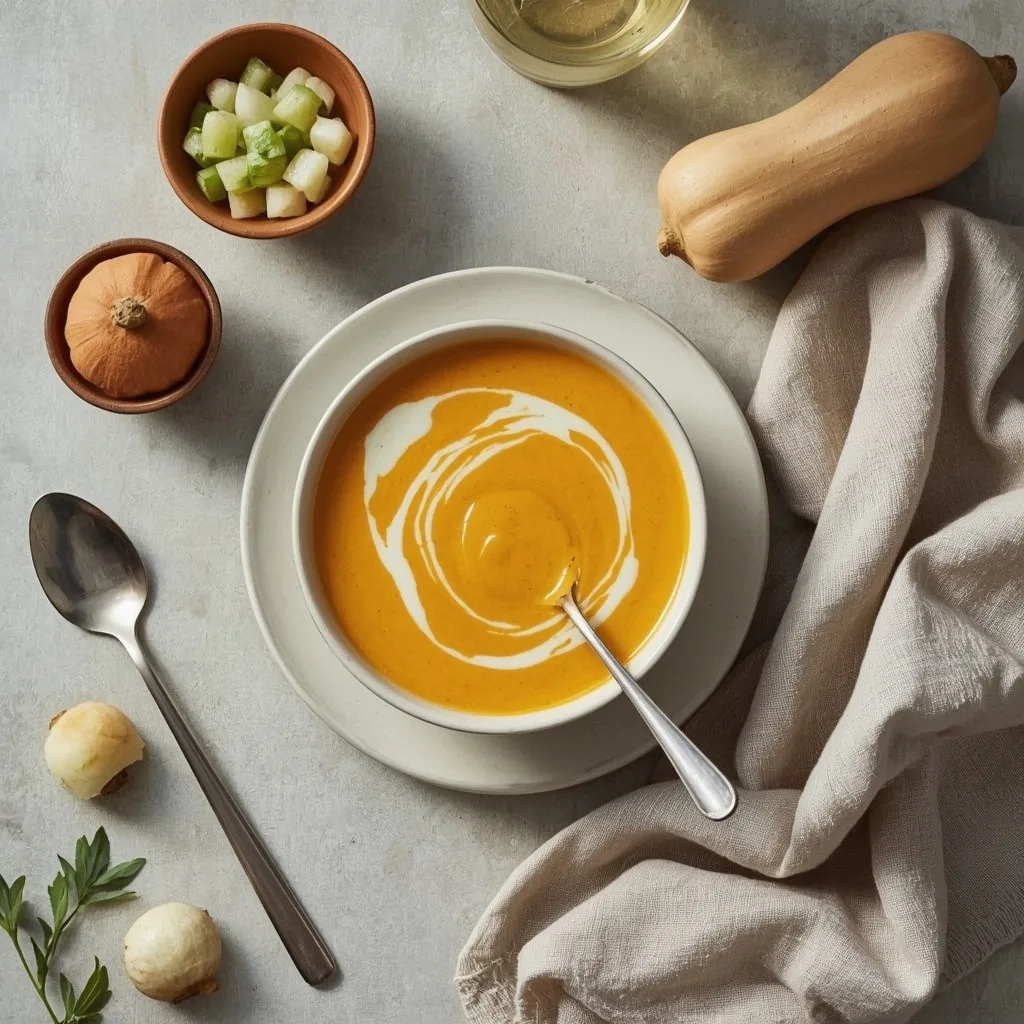
This Mary Berry Butternut Squash Soup Recipe turns a humble squash into a silky, golden bowl of British comfort food. Slow-sweated onion, carrot, and celery build a gentle sweetness, while nutmeg and a swirl of cream round it off. Everything happens on the stovetop in one pot.
You will need 15 minutes of prep and 35 minutes of cooking, so 50 minutes total from fridge to table. It suits a beginner cook, though the blending step needs a little care with hot liquid. A weeknight supper or a weekend lunch both work well here.
What is Mary Berry Butternut Squash Soup Recipe?
It is a blended vegetable soup made by softening aromatics in butter, simmering cubed butternut squash in vegetable stock, then blitzing everything smooth with a touch of cream. The texture lands somewhere between velvet and thin puree — thick enough to coat a spoon, loose enough to sip. Nutmeg gives it warmth without spice, and the finish stays savory rather than sweet. Best made in autumn and winter when squash is at its best.

Why This Recipe is Worth Trying
Plenty of soup recipes exist. This one earns its place for a few practical reasons.
- One pot, no fuss — everything cooks in a single Dutch oven, so washing up stays minimal.
- Forgiving timing — the squash simmers until tender, and a few extra minutes will not ruin it.
- Freezer friendly — portions keep for up to 3 months, making it a useful batch-cook option.
- Cheap ingredients — squash, onion, carrot, and celery cost very little for four generous servings.
- Genuinely smooth texture — sieving the blended soup takes it from good to restaurant quality.
Essential Ingredients to Make Mary Berry Butternut Squash Soup Recipe
You probably have half of these in the vegetable drawer already. The rest are easy to find.
The Aromatics
- Unsalted butter (2 tbsp) — the fat that carries the whole base; use unsalted so you control the seasoning.
- Medium onion (about 6 oz) — finely diced so it melts into the soup rather than staying chunky.
- Medium carrot (about 2 oz) — peeled and diced; adds a subtle sweetness and depth of color.
- Celery stalk (1) — the savory note that stops the soup tasting flat.
- Garlic cloves (2) — minced fresh; the jarred stuff tastes dull here.
The Body and Seasoning
- Butternut squash (2 lb) — peeled, seeded, cut into 1-inch cubes, roughly 6 cups once prepped.
- Ground nutmeg (1/4 tsp) — a small amount, but it defines the flavor; grate fresh if you can.
- Low-sodium vegetable stock (4 cups) — low-sodium lets you season to taste at the end.
- Kosher salt (1/2 tsp, plus more) — added in stages, not all at once.
- Black pepper (1/4 tsp, plus more) — freshly ground makes a real difference.
The Finish
- Heavy cream (1/2 cup) — stirred in off the boil for richness without heaviness.
- Pumpkin seeds (2 tbsp) — toasted dry for crunch on top.
- Fresh chives (1 tbsp) — finely chopped, for a bright oniony lift.
Handy Kitchen Tools for Best Results
Nothing here is specialist equipment. A few basics make the process smoother.
- Large Dutch oven — a heavy bottom prevents scorching during the long sweat; a sturdy stockpot works too.
- Stick blender — blends directly in the pot and saves transferring hot liquid; a countertop blender is the alternative.
- Fine-mesh sieve — optional but worth it if you want a really smooth finish.
- Dry skillet — for toasting the pumpkin seeds without oil.
- Wooden spoon — best for testing whether the squash crushes easily against the pot.
Step-by-Step Guide to Making Mary Berry Butternut Squash Soup Recipe
Read through once before you start — the blending stage is where most people rush. Here is the full method.
- Sweat the vegetables — melt the butter over medium-low heat, then add onion, carrot, and celery with a pinch of the measured salt. Cook 8–10 minutes, stirring every 2 minutes, until soft and translucent but not browned.
- Add the garlic — stir constantly for 45–60 seconds until fragrant. Let it brown and the whole pot turns bitter, so keep the heat gentle.
- Combine with squash — tip in the cubed squash and nutmeg, stirring until evenly coated.
- Pour in the stock — add the vegetable stock, remaining salt, and pepper, then bring to a gentle boil over medium-high heat.
- Simmer gently — drop the heat to low so the liquid barely bubbles. Part-cover and cook 20–25 minutes until the squash crushes easily against the side of the pot.
- Cool briefly — take the pot off the heat and wait 5 minutes. Blending boiling soup is a scalding risk.
- Blend in batches — fill a countertop blender no more than halfway, vent the lid, and hold a towel over the vent. A stick blender, fully submerged, is safer.
- Blend until velvety — run it 60–90 seconds with no visible flecks left. For a finer texture, pass it through a fine-mesh sieve.
- Stir in the cream — return to low heat, add the heavy cream, and warm 3–4 minutes until steaming. Boiling cream can turn it grainy.
- Adjust the consistency — loosen with 2–4 tbsp hot stock if thick; simmer uncovered 5–8 minutes if thin.
- Toast the seeds — dry skillet over medium heat, 2–3 minutes, shaking often, then move them to a plate immediately.
- Serve — ladle into warmed bowls, swirl extra cream if you like, and scatter with pumpkin seeds and chives.
What I Got Wrong (And How I Fixed It)
These are the missteps that show up most often, including a couple of my own.
- Browned aromatics — heat too high during the sweat gives you caramelized edges that muddy the color. Drop the heat and stir more often.
- Overfilling the blender — hot soup expands fast and can blow the lid. Half-full batches only.
- Skipping the sieve — celery fibres stay behind even after long blending. Pass it through a sieve if smoothness matters.
- Boiling after the cream goes in — the soup turns slightly grainy. Keep it at a gentle steam, nothing more.
- Under-seasoning at the start — salt added in stages tastes rounder than one big addition at the end.
- Scorching the seeds — pumpkin seeds go from nutty to burnt in seconds. Plate them the moment they puff.
Healthier Version of Mary Berry Butternut Squash Soup Recipe
You can lighten this considerably without losing the character of the dish.
- Swap cream for evaporated milk — use 1/2 cup evaporated milk in place of the heavy cream for a similar richness with far less fat.
- Reduce the butter — 1 tbsp butter plus 1 tbsp olive oil still softens the vegetables nicely.
- Skip the cream entirely — the blended squash is creamy enough on its own; add a swirl of yogurt at the table instead.
- Bulk it out with extra vegetables — a handful of cauliflower florets simmered with the squash adds fibre without changing the flavor much.
- Watch the salt — using low-sodium stock and seasoning at the end keeps sodium around 401mg per serving.
Ingredient Substitutions for Mary Berry Butternut Squash Soup Recipe
Most of these swaps work without any change to the method.
- 2 tbsp unsalted butter → 2 tbsp olive oil — works for a dairy-free base, though you lose some of the buttery roundness.
- 1/2 cup heavy cream → 1/2 cup coconut milk — gives a dairy-free finish with a faint coconut note; use full-fat for body.
- 4 cups vegetable stock → 4 cups chicken stock — a richer, more savory result if you are not cooking for vegetarians.
- 2 lb butternut squash → 2 lb crown prince or kabocha squash — both blend to a denser, sweeter puree; adjust stock slightly.
- 1/4 tsp ground nutmeg → 1/4 tsp ground cinnamon plus a pinch of ginger — a warmer spice profile that suits the squash well.
- 2 tbsp pumpkin seeds → 2 tbsp toasted sunflower seeds — same crunch, milder flavor, and usually cheaper.
Pairing Ideas: What to Serve With Mary Berry Butternut Squash Soup Recipe
This soup does best with simple accompaniments that add texture or freshness.
- Crusty sourdough — torn and lightly toasted, it soaks up the soup better than sliced sandwich bread.
- Cheese scones — a British classic alongside soup; warm them through and split them open.
- Green salad with vinaigrette — sharp acidity cuts through the cream and resets the palate.
- Toasted pumpkin seed topping — doubles the crunch already in the recipe; add a second scattering at the table.
- Dry apple juice or sparkling water — a crisp, cold drink keeps the meal light.
- Apple and blackberry crumble — an autumnal dessert that follows the soup without feeling too heavy.
Expert Tips to Make Perfect Mary Berry Butternut Squash Soup Recipe
Small adjustments make a noticeable difference to the final bowl.
- Cut the squash evenly — uniform 1-inch cubes cook at the same rate, so you avoid raw chunks in a smooth soup.
- Sweat, do not fry — medium-low heat and patience build sweetness; color means bitterness.
- Hold back some stock — reserve half a cup and add it after blending if the texture needs loosening.
- Taste before the cream — season the puree first, then add cream, then check again.
- Warm the bowls — a quick rinse with hot water keeps the soup steaming at the table.
- Grate nutmeg fresh — pre-ground loses its aroma fast; a microplane takes seconds.
- Rest it overnight — flavors deepen considerably after a day in the fridge.
Creative Ways to Customize Mary Berry Butternut Squash Soup Recipe
Once the base method is familiar, it is easy to take in a different direction.
- Roast the squash first — toss the cubes with 1 tbsp olive oil and roast at 425°F / 220°C for 25–30 minutes, then add after the onions for a deeper caramelized flavor.
- Add a little heat — a pinch of chilli flakes with the garlic gives a gentle background warmth.
- Blend in apple — one peeled, diced apple with the squash brings fruity acidity that balances the sweetness.
- Finish with brown butter — melt the butter until nutty before adding the vegetables for a toasted note.
- Top with croutons — cubed stale bread fried in olive oil adds a second layer of texture alongside the seeds.
- Make it curry-spiced — swap the nutmeg for 1 tsp mild curry powder and finish with a squeeze of lime.
Storing Mary Berry Butternut Squash Soup Recipe the Right Way
Handle leftovers properly and quality holds up well for several days.
- Refrigerator storage — cool within 2 hours, then seal in an airtight container for up to 4 days.
- Freezer batches — portion into containers leaving 1/2 inch headspace, then freeze for up to 3 months.
- Thawing overnight — move a portion to the fridge the night before; gentle thawing keeps the texture even.
- Keep garnishes separate — store seeds and chives in a small jar so they stay crisp.
- Label with dates — a strip of tape and a marker stops mystery containers piling up at the back.
How to Reheat Mary Berry Butternut Squash Soup Recipe (If Needed)
Reheating needs a light touch — high heat is the enemy here.
- Stovetop — medium-low heat, stirring, for 5–7 minutes until steaming. Do not let it boil or the cream can split.
- Microwave — cover and heat in 1-minute bursts, stirring between each, until hot throughout.
- From frozen — reheat gently and add a splash of stock to loosen as it warms.
- Thermos serving — preheat the flask with hot water, then fill for a packed lunch that stays warm for hours.
Nutritional Breakdown (per serving)
Based on 4 servings from the full recipe, one bowl provides the following.
- Calories — 313
- Protein — 4.8g
- Fat — 18.6g
- Saturated Fat — about 9g
- Carbohydrates — 35.2g
- Fiber — 5.9g
- Sugar — around 9g
- Sodium — 401mg
- Cholesterol — roughly 45mg
FAQs
Can I make Mary Berry Butternut Squash Soup Recipe ahead of time?
Yes, and it improves. Make it up to 2 days ahead, cool within 2 hours, and refrigerate. Add the seeds and chives just before serving.
How long does Mary Berry Butternut Squash Soup Recipe last in the fridge?
Up to 4 days in an airtight container. Reheat only what you plan to eat rather than warming the whole batch twice.
Can I freeze this soup?
Freeze for up to 3 months in portions with 1/2 inch headspace. Thaw overnight in the fridge and reheat gently, adding a splash of stock if it thickens.
Can I use frozen butternut squash?
Yes, and it saves the peeling. Use the same 2 lb weight and simmer until tender, though the texture may be slightly softer.
Why did my soup turn grainy?
Usually the cream boiled, or the soup was blended too long at high speed. Keep reheating gentle and blend in short bursts.
Is this soup suitable for vegetarians?
As written, yes — vegetable stock, butter, and cream are the only considerations. Check your stock label and swap butter for oil if you need it vegan.
Try These Recipes
Wrapping It Up
This Mary Berry Butternut Squash Soup Recipe is one of those dishes worth keeping in regular rotation — cheap, forgiving, and far better than anything from a carton. The sieve and the patient sweat are the two steps that separate good from excellent. Give it a go this week and see how quickly it becomes a habit.
PrintMary Berry Butternut Squash Soup

This silky British-style butternut squash soup has a gentle sweetness from slow-sweated onion, carrot, and celery, balanced by nutmeg and a swirl of cream. It is velvety but not heavy, with a deep golden color and a clean, savory finish. Toasted pumpkin seeds and chives add crunch and freshness.
- Prep Time: 15
- Cook Time: 35
- Total Time: 50
- Yield: 4 1x
- Category: Main Course
- Method: Stovetop
- Cuisine: British
Ingredients
- 2 tbsp unsalted butter
- 1 medium onion (about 6 oz), finely diced
- 1 medium carrot (about 2 oz), peeled and finely diced
- 1 celery stalk, finely diced
- 2 garlic cloves, minced
- 2 lb butternut squash, peeled and seeded, cut into 1-inch cubes (about 6 cups)
- 1/4 tsp ground nutmeg
- 4 cups low-sodium vegetable stock
- 1/2 tsp kosher salt, plus more to taste
- 1/4 tsp freshly ground black pepper, plus more to taste
- 1/2 cup heavy cream
- 2 tbsp pumpkin seeds (pepitas)
- 1 tbsp finely chopped fresh chives
Instructions
- Melt the butter in a large Dutch oven or heavy-bottomed pot over medium-low heat. When the butter foams and the sizzling subsides, add the onion, carrot, and celery with a pinch of the measured kosher salt. Cook for 8–10 minutes, stirring every 2 minutes, until the vegetables are soft and translucent but not browned; reduce the heat if they begin to color.
- Add the garlic and cook for 45–60 seconds, stirring constantly, until fragrant. Do not let it brown, because burned garlic turns the soup bitter. Stir in the butternut squash cubes and ground nutmeg until everything is evenly combined.
- Pour in the vegetable stock and add the remaining kosher salt and black pepper. Bring to a gentle boil over medium-high heat, then immediately reduce the heat to low. The liquid should be barely bubbling, not rolling.
- Cover the pot partially and simmer for 20–25 minutes, until the squash is completely tender and crushes easily against the side of the pot with a wooden spoon. Stir once or twice during cooking and add a splash more stock only if the pot looks dry. The vegetables should stay submerged throughout.
- Remove the pot from the heat and let it cool for 5 minutes before blending. If using a countertop blender, fill it no more than halfway, vent the lid, and blend in batches with a clean kitchen towel held over the vent. If using a stick blender, blend directly in the pot with the head fully submerged to avoid splatter.
- Blend for 60–90 seconds, until the soup is completely smooth and velvety, with no visible flecks of squash or celery. For a restaurant-smooth texture, pass the blended soup through a fine-mesh sieve into a clean pot, pressing on the solids with a ladle or spatula. Discard any fibrous bits left in the sieve.
- Return the soup to low heat and stir in the heavy cream. Warm gently for 3–4 minutes, until the soup is steaming but not boiling; boiling cream can make it taste slightly grainy. Taste and adjust with additional kosher salt and black pepper.
- If the soup is thicker than you like, loosen it with 2–4 tbsp hot vegetable stock or water, adding 1 tbsp at a time. If it is too thin, simmer uncovered over medium-low heat for 5–8 minutes, stirring often, until it coats the back of a spoon. Keep the heat low so the cream does not split.
- Toast the pumpkin seeds in a dry skillet over medium heat for 2–3 minutes, shaking the pan often, until they puff and smell nutty. Transfer them immediately to a plate so they do not scorch. Set aside.
- Ladle the soup into warmed bowls. Swirl a little extra cream over the top if you like, then scatter with the toasted pumpkin seeds and chopped chives. Serve immediately with crusty bread.
Notes
Cool leftovers within 2 hours, then refrigerate in an airtight container for up to 4 days. Freeze for up to 3 months in portions, leaving 1/2 inch headspace; thaw overnight in the refrigerator. Reheat gently on the stovetop over medium-low heat, stirring, until steaming, about 5–7 minutes; do not boil. Microwave covered in 1-minute bursts, stirring between bursts. If reheating from frozen, add a splash of stock to loosen. Oven-roasted variation: toss the squash with 1 tbsp olive oil and roast at 425°F / 220°C for 25–30 minutes until caramelized, then add to the pot after the onions; this deepens the flavor.
Nutrition
- Calories: 313
- Sugar: 9g
- Sodium: 401mg
- Unsaturated Fat: 10.8g
- Carbohydrates: 35.2g
- Fiber: 5.9g
- Protein: 4.8g
- Cholesterol: 49mg
Keywords: Mary Berry butternut squash soup, butternut squash soup, creamy butternut squash soup, British soup recipe, easy fall soup, winter warming soup, blended squash soup, stovetop soup, vegetable soup, Mary Berry recipe, cozy dinner, pumpkin seed garnish